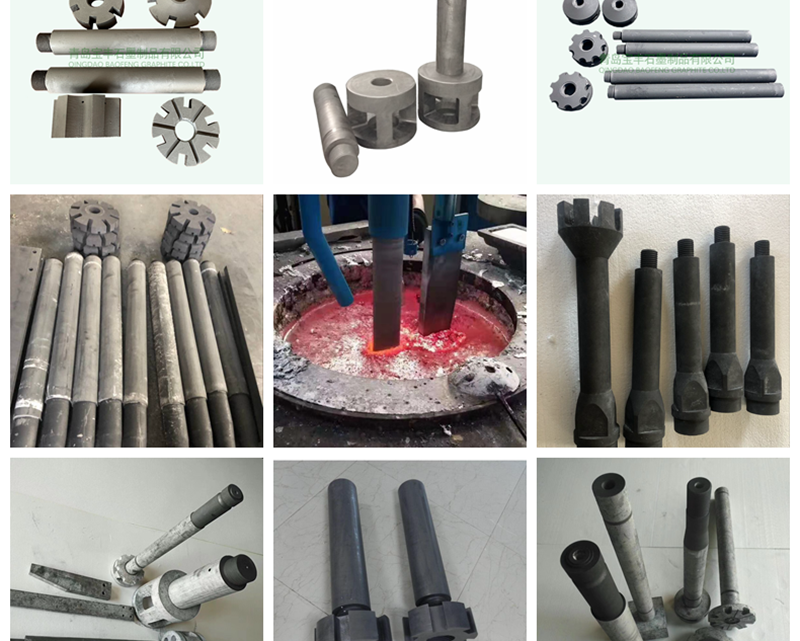
- Preheating before use: before immersing the graphite rotor in the aluminum liquid, preheat it for 5min~10min at about 100mm above the liquid surface to avoid the impact of rapid cooling on the material; before the rotor is immersed in the liquid, it must be filled with gas; The air supply can be stopped to prevent the clogging of the air holes of the rotor nozzle.
2. Isolate the air: Introduce nitrogen or argon into the purification box to ensure positive pressure in the box and isolate the external air to prevent the oxidation of the graphite rotor.
3.Rotor immersion depth: the graphite rotor is immersed in the aluminum melt at a reasonable depth, so that the strengthening sleeve is exposed to about 80mm of the aluminum liquid surface and immersed in about 60mm below the liquid surface, which can effectively increase the rotor’s resistance to oxidation loss and erosion.
4.The transmission system is stable: the graphite rotor and the transmission system are connected by a connecting rod (tube). The deformation of the connecting rod under high temperature for a long time, or the loosening of the relevant parts of the transmission equipment will affect the centering and operation of the rotor. The smoothness of the graphite rotor is easy to break or damage the graphite rotor.
5. The argon or nitrogen gas should be pure: if the pipeline, joints and other parts leak, the argon or nitrogen gas flowing into the aluminum melt will be impure, which will seriously oxidize the upper part of the rotor, and even cause the jet holes of the lower rotor to be damaged. It is oxidized, which will greatly shorten the service life of the rotor.
The advantages of our rotors: 1. Reduce processing costs 2. Reduce consumption of inert gas 3. Reduce aluminum content in slag 4. Reduce labor costs 5. Improve performance and longer replacement cycles 6. Improve reliability and reduce maintenance costs.